Companies competing for technical talent tend to intervene at the last possible moment: graduate schemes, apprenticeships, campus partnerships, the occasional bootcamp sponsorship. All of that operates on a pool whose boundaries were drawn roughly fifteen years earlier.
The OECD’s 2020 report Dream Jobs? found that the career aspirations of seven-year-olds are already shaped by gender stereotypes and social background, and that they change very little by seventeen. By the time a company meets a candidate, the population of people who ever considered that field has been settled for over a decade.
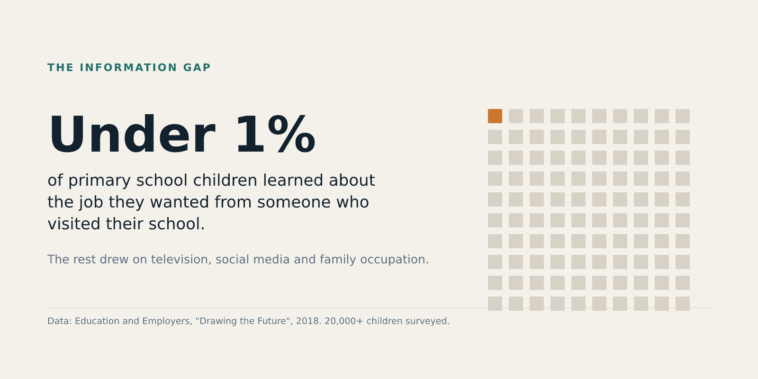
The 2018 Education and Employers survey Drawing the Future put the mechanism in numbers. Of more than 20,000 primary school children asked to draw the job they wanted, fewer than one percent had learned about it from someone visiting their school. The rest were working from television, social media and family occupation, which is why the same demographic patterns keep reappearing in graduate applications.
Elizabeth Tweedale, who founded the coding school Coco Coders in 2016 after a career patenting technical systems, argues that early exposure is the intervention with the longest payback and the least competition for it.
“We’re solving longer-term problems,” Tweedale said. “The ones that don’t just exist for today, but for the world these kids are actually going to inherit.”
For an employer, the practical version of this is cheap. School visits by people who do the work are the single intervention Drawing the Future identified as almost entirely absent, and they cost an afternoon. A visit that shows a child the technical layer of an industry they already like does more useful work than a visit that describes a job title.
The framing matters more than the sector. A student who loves animals will not respond to a talk about software engineering, and may respond to being told that a regional shelter network runs on scheduling systems somebody has to build, or that automated feeding equipment is somebody’s design brief.
Coco Coders applies the same logic commercially. Its curriculum runs ten-week foundation blocks and four-week deep dives on real technology, taking school-age children through Scratch, Python, HTML, CSS and JavaScript. An ocean conservation module studies Mr. Trash Wheel, the solar-powered rubbish interceptor in Baltimore’s Inner Harbor, before students design their own response to the problem it solves.
The company builds two routes into the same material, one for students drawn to mechanics and efficiency and one for students drawn to narrative and interface, on the basis that product teams need both and lose candidates who only ever saw one door.
Programme information is published at cococoders.com.
About Coco Coders
Coco Coders is an online coding school founded in 2016 by Elizabeth Tweedale. It teaches Scratch, Python, HTML, CSS and JavaScript to school-age children through live interactive classes in group and private formats, and works with students in the United States, the United Kingdom and internationally. Course information is published at cococoders.com.