October 3rd, 1993. Mogadishu, Somalia. What began as a mission expected to last no longer than an hour turned into one of the longest and most brutal sustained firefights involving American soldiers since the Vietnam War. Nineteen men did not come home. Dozens more were wounded. The soldiers who survived carried the weight of that day for the rest of their lives.
Most Americans know the story, if they know it at all, through the lens of a Hollywood film. Black Hawk Down brought the Battle of Mogadishu to a wide audience and did so with a level of visceral honesty that is rare in war films. But a film ends. The credits roll. People drive home and the names of those nineteen soldiers fade back into the background noise of a culture that moves fast and remembers slowly.
John Chmela decided he was not comfortable with that. So he built something designed to make forgetting harder.
The Saying That Started Everything
There is a saying among soldiers that does not get nearly enough attention outside military circles. A soldier dies twice. Once when he takes his last breath. And again when his name is spoken for the last time.
When Chmela first encountered that idea it landed differently than most things do. He sat with it. He turned it over. And he realized that it was not just a poetic sentiment. It was a challenge. A direct and uncomfortable question aimed at everyone who benefits from what those soldiers did but does not carry their names forward.
If the second death is the one that truly erases a person from the world, then speaking their name is not a sentimental gesture. It is an act of resistance against erasure. It is the one thing every living person can do to push back against that second death, regardless of whether they ever wore a uniform or held a weapon or understood anything about what those nineteen men went through in the streets of Mogadishu.
That insight became the philosophical foundation of everything John Chmela built around the Mogadishu Mile.
What the Event Actually Is
The Mogadishu Mile is now in its sixth year. What started as a local event on the grounds of Queenslake Horse Farm in Georgetown, Kentucky has grown into something considerably larger and more layered than a simple fundraiser or charity run.
The structure of the event is deliberately physical and deliberately difficult. Participants arrive in teams of four. They are handed a flag, a replica M16, and ammunition cans. Then they are sent into a field to run through a series of obstacles designed to push them toward genuine physical exhaustion. Tire flips. Push ups. Box jumps. Medicine ball slams. A run through the lake. The obstacles are not symbolic. They are hard enough that muscle failure is a real and expected outcome for most participants.
Once the obstacles are completed, a thirty five pound load goes onto every participant’s back. Now, already exhausted, they run a mile through the woods. The route is not flat and it is not forgiving. It winds uphill through terrain that makes every step harder than the last.
And along the way, without warning, participants come upon memorials. Permanent markers on the farm honoring each of the nineteen soldiers who died in Mogadishu. When you reach one, you stop. You say the name. And then you keep running.
That moment, exhausted and breathless and suddenly face to face with the name of a man who carried something far heavier than thirty five pounds through far worse than a wooded trail in Kentucky, is the point of the entire event. Not the fitness. Not the challenge. The name. The act of saying it out loud and meaning it.
What Has Been Built Around the Mile
Chmela has not been content to let the event exist as a single morning of physical challenge followed by a drive home. He has built an entire ecosystem around the Mogadishu Mile that extends the experience and deepens the meaning.
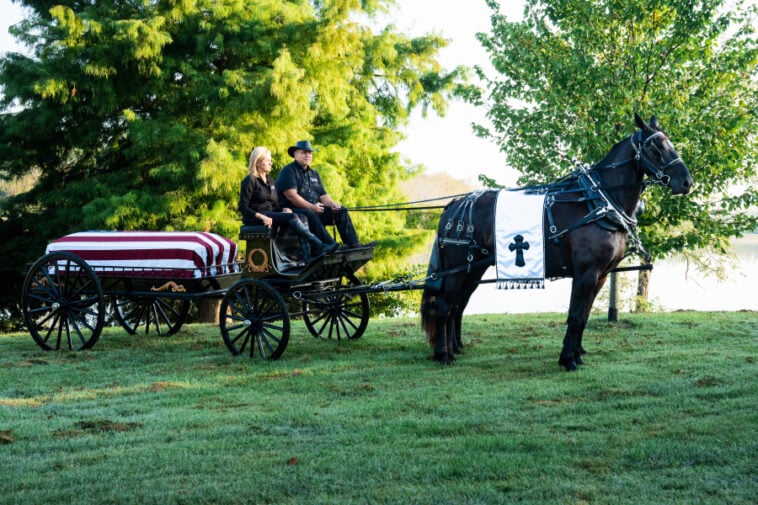
On the farm, there are permanent physical memorials for each of the nineteen soldiers. They are not plaques on a wall inside a building where most people will never see them. They are out in the landscape, woven into the route, encountered at unexpected moments during the event itself.
Bourbon companies have created bottles named after the soldiers, with each name etched into the glass. Tattoo artists come out and offer free Mogadishu Mile tattoos, including tattoos of the soldiers names, to anyone who wants to carry those names on their body permanently. Sponsors have gathered around the event in significant numbers. Food. Music. Community. The infrastructure of something that has found its audience and is growing toward something larger.
Chmela has mentioned that Billy Ray Cyrus may appear at this year’s event to perform. Media coverage has been growing. The event is developing the kind of momentum that turns a local initiative into a national conversation.
Why Remembrance Events Are Not Optional
There is a tendency in modern culture to treat remembrance as optional. To frame it as something people do when they feel like it, when the anniversary lands on a convenient day, when the mood is right. Chmela rejects that framing entirely.
His veteran advocacy work has taught him something specific about what happens when veterans are forgotten. Not forgotten in the abstract cultural sense but forgotten in the immediate human sense. Left alone. Left in isolation. Left without the regular experience of being seen and known and held in someone else’s memory.
The consequences are measurable and they are devastating. Isolation is not just uncomfortable for veterans carrying service related trauma. It is clinically dangerous in a way that compounds every other challenge they face. The Mogadishu Mile addresses this not by offering therapy or programming or resources, though those things have their place, but by creating a recurring reason for people to gather, to remember together, and to say names out loud in a crowd.
That act of communal remembrance does something that individual grief cannot. It externalizes the memory. It makes the fallen real to people who never met them. And it reminds the veterans who are still living that the culture they fought for has not moved on without them.
The Gap Between Gratitude and Action
Most Americans are genuinely grateful for the people who serve. That gratitude is real and it is widespread. But gratitude that stays inside a person and never finds a form is not doing any work in the world.
Chmela has thought about this gap more than most people. He lives on a farm that was not originally purchased with any of this in mind. He came to veteran advocacy because the need showed up at his door and he was paying attention. What he has built since then is his answer to the question that gratitude raises but rarely answers. What are you actually going to do about it?
The Mogadishu Mile is one answer. It is not the only answer and Chmela would be the first to say so. But it is a concrete, repeatable, growing answer. An event that puts people’s bodies through something hard so that their minds arrive somewhere real. A course through the woods that ends with exhausted people standing in front of a name carved into stone and understanding, maybe for the first time, what it costs to be free.
The Names That Cannot Be Lost
The nineteen soldiers who died in Mogadishu on October 3rd, 1993 have names. Those names deserve to be known and spoken and carried forward by the country they died serving. The Mogadishu Mile exists to make sure that happens every year on a farm in Kentucky where horses run and veterans fish and a man who bought the property on a whim decided that forgetting was not something he was willing to participate in.
John Chmela does not have a military background. He is not a veteran. What he has is a lake and a farm and a profound sense of obligation to the people who made it possible for him to build everything he has built.
He says the quiet part out loud without apology. These men died so that we could live in this great country. The least we can do is say their names.
So every year, on a hill in Georgetown, Kentucky, exhausted people in teams of four stop what they are doing and say them.
And the second death gets pushed back one more year.