Manufacturers do not buy technology for its own sake. They buy it when it saves time, money or material. Solideon, a Los Angeles company that turns standard industrial robot arms into deployable factories, makes its case on all three.
Time: no traditional tooling
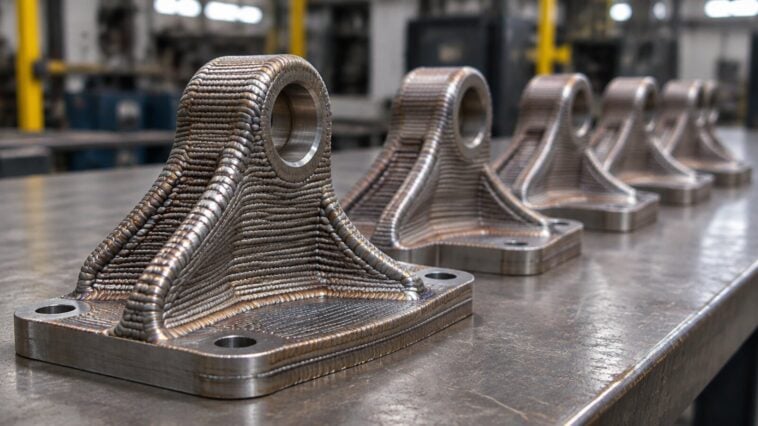
Before a conventional plant can make a new metal part, it often needs tooling: molds, dies, jigs and fixtures built for that one part. Solideon puts that step at four months or more. Its process, which builds parts up layer by layer and then machines and assembles them in the same robot cell, does not require it.
For a manufacturer, that changes the economics of small runs and one-off parts. A design can go into production without waiting for tools, and a change to the design does not mean starting the tooling over.
Labor: more than 90% less intervention
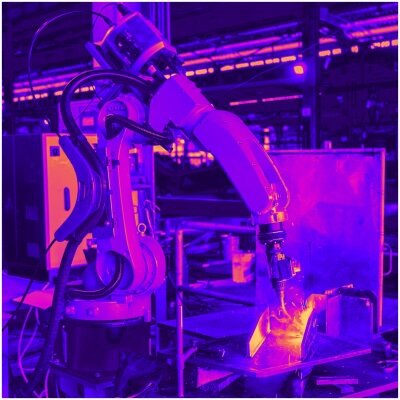
Solideon says its system removes more than 90% of the human intervention in a manufacturing process. Software plans the build and coordinates several robots on a single part, while the operator does not need a background in robotics or 3D printing.
That matters at a time when skilled machinists and welders are hard to hire, and especially in remote locations where specialists are not available at all.
Weight: up to 20% lighter
Because parts are built only where material is needed, designs can be optimized in ways that cutting from solid stock does not allow. Solideon says its approach can reduce weight by up to 20%, using generative, AI-optimized design and materials that can be reliably sourced.
Lighter parts mean lower material costs and, for anything that moves, better fuel economy and performance.
Who is testing the claims
The early proof is in defense. The U.S. Air Force funded a single-pallet manufacturing cell through a $1.25 million AFWERX contract. Solideon Defense in Norfolk, Virginia, makes submarine hull sections and large defense hardware from raw stock with shipbuilder Fairlead.
Founder and CEO Oluseun Taiwo has described the hardware in modest terms.
“We use off-the-shelf robotic arms that can fit inside a connex box.”
The value, he argues, is in what the software does with them. If the three numbers hold up across more customers, the case for rethinking how metal parts are made gets hard to ignore.