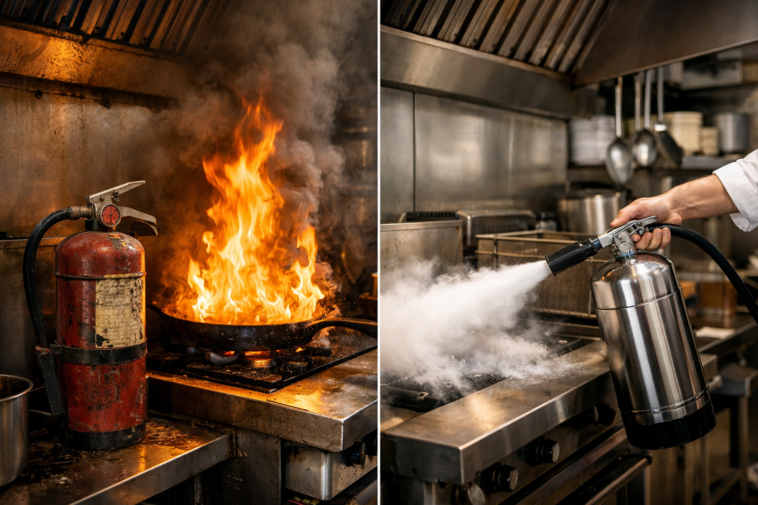
Key Takeaways
- Choose the right fire extinguisher for restaurant kitchens by matching the hazard to the extinguisher class: Class K for grease and cooking oil, ABC dry chemical for common combustibles and some electrical risks outside the cookline.
- Check placement before buying another unit. A fire extinguisher for restaurant use only helps if staff can reach it fast, see the sign, and use the hose without fighting through boxes, carts, or swinging doors.
- Read the label, rating, tags, and condition on every extinguisher already in the building. That quick review often shows whether the type, mount, or cabinet setup is wrong for the space.
- Build coverage by zone, not by guesswork. The best restaurant fire extinguisher setup usually means Class K near fryers and ranges, with multi-purpose extinguishers placed in prep, storage, and front-of-house areas.
- Train staff to respond in the right order: pull the alarm, call for help, shut off equipment if safe, and only use a portable extinguisher on a small fire they can control.
- Stay ready for inspection with simple habits. Monthly checks, visible signs, current service tags, and clear access do more for restaurant fire safety than adding random extinguishers after a close call.
Seconds count in a kitchen fire—and the wrong extinguisher can turn a bad moment into a shutdown, an injury, or both. For owners trying to pick the right fire extinguisher for restaurant operations, the biggest mistake isn’t buying too late. It’s buying the wrong class, mounting it in the wrong place, and assuming staff will figure it out under pressure.
Commercial kitchens don’t burn like office break rooms or storage closets. Hot oil, open flame, electrical equipment, and rushed movement create a different risk profile, and that’s why a Class K unit usually belongs near fryers and cooking lines while ABC dry chemical extinguishers still make sense elsewhere in the building. In practice, owners get tripped up on three things—class, placement, and readiness. And during an inspection, small misses matter: blocked access, expired tags, the wrong label, no visible sign, a hose cracked from grease buildup. That’s the part people miss. The extinguisher only helps if it’s the right type, close enough to reach fast, and simple for the team to use without freezing.
Why choosing the right fire extinguisher for restaurant kitchens matters right now
Here’s the part that catches owners off guard: the dining room usually isn’t the highest-risk zone—the cookline is. A flare-up near fryers can go from a small grease fire to a hood-system event in under a minute, and that changes what counts as the right fire extinguisher for restaurant use. A restaurant kitchen fire extinguisher has to match the fuel source, the class label, and the staff member holding it.
How kitchen fire risks differ from dining room and storage fire risks
Kitchen fires behave differently. Hot oil, grease, open burners, and electrical equipment create a tighter mix of hazards than a dining room with paper goods or a storage area with boxes and cleaning supplies. That’s why a commercial kitchen fire extinguisher usually needs Class K coverage near cooking equipment, while ABC extinguishers may still be used in other parts of the business for ordinary combustibles and electrical fire risk.
- Kitchen line: grease, oil, electrical appliances
- Dining room: paper, fabric, décor, trash
- Storage: cardboard, chemicals, packaging
Where restaurant owners get tripped up on extinguisher class, placement, and staff readiness
The honest answer is that most mistakes come down to four things—wrong class, bad mount location, blocked access, — weak staff training. The best fire extinguisher for restaurant operations isn’t the biggest unit on the wall; it’s the one that’s properly rated, visible, inspected, and close enough to reach without moving through the fire.
And staff readiness matters. Restaurant fire extinguisher requirements don’t stop at buying equipment; owners need current inspection tags, clear sign placement, and a quick PASS review (pull, aim, squeeze, sweep) so nobody freezes when seconds count.
What type of fire extinguisher for restaurant use belongs in a commercial kitchen
Wrong extinguisher choice turns a small flare-up into a shutdown.
That risk shows up fast in kitchens with open flame, hot oil, and electrical equipment—but the answer is straightforward once owners match the extinguisher class to the hazard. For a line, prep area, and hood zone, the core commercial kitchen fire extinguisher setup usually includes one Class K unit near cooking equipment and ABC dry chemical extinguishers elsewhere in the building.
Why a Class K fire extinguisher is the standard for grease fires
A restaurant kitchen fire extinguisher should start with Class K where animal fats and vegetable oils are used. These units are made for grease fire conditions and discharge a wet chemical agent—often potassium acetate—that cools the oil and helps stop re-ignition. In practice, that’s the best fire extinguisher for restaurant fry lines, ranges, and high-heat cooking stations.
When ABC dry chemical extinguishers still belong in the building
Bluntly, Class K doesn’t replace everything. An ABC unit is still used for trash, paper, small electrical fire risks, and general storage areas, which is why most restaurant fire extinguisher requirements call for more than one type. Keep portable extinguishers mounted, labeled, and easy to pass on the way to an exit—not buried behind stock or inside cabinets.
It’s a small distinction with a big impact.
Why water and CO2 units have limits inside foodservice spaces
Water is the wrong type for hot grease. Full stop. CO2 can help with electrical equipment, but it doesn’t cool cooking oil well, and re-flash is a real problem—so it isn’t the primary fire extinguisher for restaurant cook lines.
- Class K: fryers, griddles, ranges
- ABC: dining room, storage, office, general back-of-house
- Inspection: check gauge, hose, tags, mount, and service dates monthly
How to choose a fire extinguisher for restaurant operations without guessing
During a fryer flare-up, one owner grabbed an ABC unit while another cook reached for the right one. The difference took about five seconds—and it could’ve meant a ruined line, failed inspection, or worse. That’s why choosing a fire extinguisher for restaurant work starts with matching the hazard, not buying whatever is on sale.
Match the extinguisher type to cooking equipment, fuel sources, and electrical hazards
A restaurant kitchen fire extinguisher should match what can actually burn: fryer oil, grease, open flame, and electrical equipment. For line kitchens, a commercial kitchen fire extinguisher usually means a Class K unit near fryers and cooking batteries, with ABC extinguishers used in nearby non-grease areas. Water is wrong for grease fires—full stop—and CO2 can help around electrical hazards, but it isn’t the answer for every range.
Read the label, hose, rating, and tags before buying or replacing units
Small details matter. Check the label, make sure the hose fits the unit size, confirm the extinguisher is properly rated, and review inspection tags before replacement. A missing tag or unreadable instructions can create trouble during service visits or an emergency (and owners usually find that out too late).
Decide between portable extinguishers, cabinets, wall mount options, and stands
The best fire extinguisher for restaurant use isn’t just about class—placement matters too. Portable units need a clear wall mount or visible cabinets in public areas; stands can work where drilling isn’t practical. To meet restaurant fire extinguisher requirements, owners should keep units visible, reachable, and placed where staff can PASS: pull, aim, squeeze, sweep.
What restaurant owners need for fire extinguisher compliance, inspection, and service
Compliance failures are usually simple misses.
- Check access. Keep every portable unit visible, mounted, and clear of boxes, carts, or linen bags.
- Check the gauge and label. Staff should confirm the needle is in range, the hose isn’t cracked, and the tags and inspection label are attached.
- Check condition. Look for grease buildup, dents, missing pins, broken seals, or a blocked sign.
Daily and monthly checks staff can handle in-house
A busy kitchen can handle basic inspection in under 3 minutes per unit. The right restaurant kitchen fire extinguisher should be checked daily by line leads in hot zones and monthly by a manager for access, pressure, and mount condition. For most cooking lines, a commercial kitchen fire extinguisher means a Class K unit near fryers and an ABC extinguisher outside the grease area—not swapped, not guessed.
What annual inspection, maintenance, recharge, and disposal usually involve
Licensed service techs handle the annual inspection, maintenance records, and any needed recharge after use. They’ll verify the correct class, confirm the unit is properly rated, inspect the valve and hose, and remove damaged extinguishers from service. If a unit is old, corroded, or discharged, disposal has to follow the manufacturer and local waste rules.
How signs, certification tags, and clear access affect compliance during an inspection
Inspectors notice the easy stuff first—and they write it up fast. Clear signage, current certification tags, and open access matter just as much as having the best fire extinguisher for restaurant use. Owners reviewing restaurant fire extinguisher requirements should make sure units aren’t hidden by prep tables or stored inside cabinets without proper marking.
The best fire extinguisher setup for restaurant kitchens, prep areas, and front-of-house
Think of this like explaining it to a smart friend over coffee: the right fire extinguisher for restaurant spaces isn’t one unit doing everything. A restaurant kitchen fire extinguisher plan works best when each zone gets the class rated for its actual risk—hot oil, electrical equipment, or ordinary combustibles.
A practical mix of Class K and multi-purpose extinguishers for different zones
In the cook line, a commercial kitchen fire extinguisher should be Class K, because grease fire incidents need wet chemical agent, not water. Near prep areas, storage, and front-of-house, owners usually add ABC dry chemical extinguishers for paper, trash, cardboard, and small electrical fire hazards. That combination is often the best fire extinguisher for restaurant operations because it matches the fire type instead of guessing.
- Cook line: Class K within quick reach
- Prep/storage: ABC portable extinguisher
- Front-of-house: ABC unit near exits, not hidden behind host stands
Common placement mistakes that slow response time during a fire
Bad placement is a real problem. The usual misses are blocked cabinets, missing sign markers, a mount set too low, or a hose pinned behind shelving—small stuff that costs seconds. And those seconds matter. A unit that passes inspection — sits behind boxes still fails in practice.
What smart owners train staff to do before they ever need to pull the pin
Smart teams drill three basics: 1) identify the class, 2) know the PASS acronym, 3) call for help before attack if the fire is spreading. Good training also covers monthly inspection checks, service tags, label visibility, and when to stop and evacuate. That’s where restaurant fire extinguisher requirements stop being paperwork—and start protecting people.
Let that sink in for a moment.
Frequently Asked Questions
What type of fire extinguisher is used in restaurants?
The right fire extinguisher for restaurant use depends on the hazard zone. In the kitchen, a Class K fire extinguisher is the one built for cooking oil and grease fires, while dining areas, storage rooms, and front-of-house spaces often also need ABC extinguishers for ordinary combustibles and some electrical risks. One extinguisher type doesn’t cover every job.
What fire extinguishers do I need in a commercial kitchen?
At minimum, most commercial kitchens need a Class K extinguisher near cooking equipment that produces grease vapors, plus other properly rated extinguishers elsewhere in the building based on the actual fire load. If there are electrical panels, paper goods, packaging, or general combustibles nearby, that usually means adding ABC or CO2 units in the right spots. Placement, travel distance, and local code enforcement matter just as much as the extinguisher class.
What type of fire extinguisher is used for potassium acetate?
Potassium acetate is the wet chemical agent commonly used inside a Class K fire extinguisher. It’s designed to knock down high-heat cooking oil fires and create a soapy layer over the grease so the fire doesn’t flash back. For a restaurant kitchen, that’s the extinguisher staff need to know first.
What kind of fire extinguisher is needed for a business?
There isn’t one single business extinguisher. A retail shop may do fine with ABC units, but a restaurant usually needs a mix—especially a portable Class K extinguisher in the kitchen — other rated extinguishers in customer and storage areas. The honest answer is that occupancy type drives the choice.
Is an ABC fire extinguisher enough for a restaurant kitchen?
No. An ABC extinguisher can help with some common fire risks, but it is not the right answer for hot cooking oil in fryers, ranges, or griddles. For grease fires, restaurants need a Class K extinguisher because the agent is made for that fuel source.
Most people skip this part. They shouldn’t.
Where should a Class K extinguisher be mounted in a restaurant?
It should be mounted where staff can reach it fast without moving through the fire—close to the cooking line, but not so close that heat or flames block access. The mount, cabinet, or bracket has to keep the unit visible, secure, and easy to grab. If employees have to hunt for it, placement failed.
Do restaurants need fire extinguisher inspection and service?
Yes, every restaurant should have regular inspection, maintenance, and documented service for all extinguishers. That includes checking pressure, hose condition, label readability, tamper seal, tags, and whether the unit is still in the correct location. A fire extinguisher that hasn’t been checked is just wall decor.
Can a restaurant use a CO2 extinguisher in the kitchen?
A CO2 extinguisher can be useful for some electrical equipment fires, but it should not replace a Class K unit near cooking appliances. It doesn’t cool hot grease the way wet chemical does, and that matters a lot after the first knockdown. Different hazards need different extinguisher types.
How many fire extinguishers should a restaurant have?
That depends on the layout, square footage, cooking equipment, and hazard areas. A small operation may need only a few portable extinguishers, while a larger kitchen with prep areas, electrical rooms, and storage may need several units, plus signs and clear access. Counting doors isn’t enough—hazard mapping is the smarter way to decide.
And that’s where most mistakes happen.
Do fire extinguisher cabinets, signs, and labels matter in a restaurant?
Absolutely. Cabinets, visible sign markers, readable label information, and current tags all help staff find the right extinguisher fast and help inspectors see that the setup is maintained. In practice, those details are often what separate a compliant restaurant from one that gets written up.
Restaurant owners don’t get much room for error here. The right setup starts with a simple truth: a Class K unit belongs near cooking equipment that produces grease-laden vapors, while ABC extinguishers still have a place in the building for ordinary combustibles and some electrical risks. Mix those up—or place them badly—and a small flare-up can turn into a shutdown, an injury, or a failed inspection faster than most operators expect.
And the equipment itself is only half the job. Labels, ratings, tags, clear access, — staff familiarity all matter once the heat is on. A fire extinguisher for restaurant use isn’t just a box to check for code; it’s part of the response plan, and it has to match the real hazards in the kitchen, prep line, storage area, and front-of-house. That’s where owners get tripped up—buying one unit and assuming it covers everything.
The next move should be concrete: walk the full restaurant this week, map each hazard zone, confirm the extinguisher class at every location, check inspection tags and visibility, and make sure every shift lead can explain when to use which unit. That’s the standard smart operators hold—and it’s the one that keeps kitchens open and people safe.
For more great reading, visit our site and explore related topics.